.png)
Flexofc Journal
10 Benefits of Coworking Spaces for Businesses and Professionals

Modern coworking spaces are no longer just shared desks for freelancers. They have become strategic real estate tools that can reduce upfront CapEx limit lease lock-in risk and give businesses access to plug-and-play office infrastructure.
That matters because the traditional five-year office lease assumes you know what your workforce will look like years from now. Most businesses don't.
A team can go from 20 people to 45 move from fully office-based to hybrid or open a second city within a year. Yet a conventional lease can leave you paying for space designed around yesterday's headcount.
India's flexible workspace market reflects this shift. JLL reported that flex space accounted for 25.9% of India's gross office leasing in Q1 2026. CBRE also reports that organisations are increasingly using flexible workspaces as part of longer-term real estate strategies.
Here are the benefits that actually matter when you're evaluating a workspace.
1. Lower Upfront CapEx and Less Capital Risk
A traditional office can require a surprisingly large cheque before the first employee sits down.
Furniture interiors networking access control meeting rooms pantry equipment and fit-outs all add up. Then there's the security deposit and the time spent coordinating contractors.
With coworking most of that infrastructure already exists.
You pay for usable workspace rather than building an office from an empty floor plate. Depending on the setup businesses can significantly reduce initial capital expenditure although the actual saving varies by location fit-out specification and lease structure.
For a startup protecting cash flow that difference can matter more than a slightly lower monthly rent.
The real advantage is not simply cheaper space. It's keeping capital available for the business.
2. Scale Your Office With Your Headcount
Headcount rarely grows in a straight line.
You might need 12 seats today 20 after a new client signs and 35 six months later. A traditional lease isn't designed for that kind of movement.
Flexible workspaces let companies add seats move into larger private offices or use additional meeting and collaboration space without rebuilding the entire workplace.
This is particularly useful for startups project teams and companies entering a new city.
And it works in reverse too. If a project ends and ten seats are no longer required you're not necessarily stuck carrying unused space for years.
3. Enterprise-Grade Technology Without Building It Yourself
A serious office needs more than fast Wi-Fi.
Businesses may require multiple internet connections backup power secure access systems meeting-room technology and on-site technical support.
Established coworking operators invest in this infrastructure across the building allowing smaller companies to access facilities that would be expensive to create independently.
For an operations team there's another benefit: fewer things to troubleshoot.
When the internet goes down at 10:30 a.m. before a client call someone else should ideally be worrying about the network.
4. Better Locations Without Taking a Huge Lease
Location still affects hiring attendance and client meetings.
A company may want an address in Cyber City Golf Course Road Bengaluru's Outer Ring Road Mumbai's BKC or Hyderabad's HITEC City but taking a large conventional office in these markets isn't always practical.
Coworking allows businesses to occupy smaller footprints in established commercial locations.
That can reduce commute friction for employees while keeping the company close to clients business districts and transport links.
A cheaper office far away isn't necessarily cheaper if employees spend an extra hour commuting every day.
5. Networking That Can Actually Lead to Business
The networking benefit of coworking gets exaggerated sometimes.
Simply putting 200 companies in one building doesn't magically create partnerships.
But proximity does create opportunities that don't exist in a conventional private office.
A founder might meet a recruiter in the pantry. An HR manager may discover a payroll provider through another member. A marketing team may find a production partner at an event.
The value comes from repeated informal interactions rather than forced networking sessions.
For freelancers and small businesses this can be particularly useful because the coworking community becomes an additional business network.
6. Outsourced Facility Management
Running an office means managing a long list of things nobody puts in the original office budget.
Cleaning. Security. HVAC. Pantry supplies. Maintenance. Visitor management. Repairs.
Coworking transfers much of that operational responsibility to the operator.
This doesn't mean facility management disappears. You're simply not hiring separate vendors and coordinating them yourself.
For a small operations team that can free up hours every week.
And for a larger company it can allow workplace teams to focus on employee experience and business requirements rather than chasing a broken air-conditioner.
7. Better Focus and Workplace Ergonomics
A good coworking space should make it easier to work not simply look good on Instagram.
The practical details matter: proper desks ergonomic chairs quiet zones phone booths and meeting rooms that don't require shouting across an open floor.
Different employees also need different environments.
Someone working on a financial model may need two hours of uninterrupted concentration. A sales employee might spend most of the afternoon on calls.
A well-designed flexible workspace gives people options instead of forcing everyone into the same seating arrangement.
8. Stronger Support for Hybrid Teams
Hybrid work has changed how companies think about office space.
CBRE's 2025 India Office Occupier Survey found that 94% of surveyed occupiers preferred employees to spend at least three days a week in the office while 55% reported average office utilisation above 75%.
The takeaway isn't that every company needs a bigger office.
It means utilisation needs to be understood before committing to space.
A hybrid company may need private offices for core employees while using hot desks for employees who visit occasionally. Some teams may also need day passes or access to another city when travelling.
Flexible workspace makes those arrangements easier to manage.
9. Access to Premium Amenities Without Paying for Them Full-Time
A traditional office might need its own boardroom training room event area and podcast or content studio.
But how often does each one actually get used?
Coworking lets companies access shared amenities based on actual demand.
A team might need a large conference room twice a month but doesn't need to dedicate 500 sq. ft. to one permanently.
That changes the economics of office planning.
Paying for shared capacity can make more sense than owning capacity you rarely use.
10. A More Professional Business Address and Client Experience
Perception isn't everything but it matters when you're meeting a client for the first time.
A professional reception area meeting room visitor management system and well-maintained office can create a stronger experience than a makeshift rented office.
This is especially useful for startups and smaller firms that want a credible business presence without spending heavily on office interiors.
The right workspace can also give employees a workplace they're comfortable bringing clients into.
Traditional Lease vs Coworking: Quick Comparison
Factor | Traditional Commercial Lease | Coworking / Flexible Office |
Upfront CapEx | High especially with fit-outs | Usually much lower |
Furniture & interiors | Tenant-managed | Generally provided |
Facility management | Tenant responsibility | Operator-managed |
Lease commitment | Often multi-year | More flexible |
Scaling speed | Slow | Faster |
Hybrid workforce support | Requires planning | Built into many offerings |
Networking | Mostly internal | Access to wider member community |
Amenities | Paid for by tenant | Shared and often bookable |
Location flexibility | Limited once leased | Multiple locations may be available |
The point isn't that traditional leasing has become irrelevant.
For a mature company with predictable headcount specific security requirements and a long-term real estate strategy a conventional lease can still make sense.
But flexibility has become a legitimate part of corporate real estate planning. JLL's 2026 research describes flex space as increasingly integral to occupier portfolio strategies particularly for enterprise demand and operating-expense-based workspace models.
Where FlexOFC Fits Into the Decision
The difficult part isn't knowing that coworking exists. It's finding the right space.
Pricing can vary considerably between buildings even within the same locality. A 20-seat requirement in Sector 44 Gurugram is a very different search from a five-person team looking around Golf Course Road.
FlexOFC helps businesses compare verified coworking spaces across 50+ Indian cities rather than contacting operators one by one.
You can compare locations seating options and amenities while FlexOFC's zero-brokerage model removes the traditional middleman fee from the workspace search.
For larger teams the same approach can be used when evaluating enterprise workspace solutions. For smaller teams and professionals coworking spaces can be compared based on location and requirements.
The useful part is having someone help narrow the list. If you tell an expert "We need 18 seats two private cabins good client access and a metro-friendly location" you don't need to manually inspect every listing in the city.
Frequently Asked Questions
Are coworking spaces suitable for enterprise companies?
Yes. Enterprise companies increasingly use flexible workspace for satellite offices project teams expansion into new markets and hybrid workforce strategies. The requirement is to choose a space that meets the company's privacy technology security and operational needs.
How much can businesses save with coworking?
There isn't one fixed saving percentage. It depends on the city lease structure fit-out requirements deposit office size and utilisation. The biggest financial benefit is often avoiding large upfront fit-out costs and paying for more space than the business actually uses.
Do coworking spaces offer private cabins?
Yes. Many operators offer private cabins and dedicated offices alongside open desks. Some also provide meeting rooms boardrooms and phone booths for confidential conversations.
Is coworking better than a traditional office lease?
It depends on the business. Coworking generally offers greater flexibility and lower setup responsibility while traditional leasing can provide more control for companies with stable long-term requirements.
How do I find a suitable coworking space?
Start with the requirements that actually affect your decision: headcount preferred location budget privacy needs and expected growth. Then compare verified options rather than choosing based only on photos or advertised rent.
You can use FlexOFC to compare verified coworking spaces and get free expert shortlisting based on your team's requirements without brokerage.
Need Help With This Topic?
Talk to the Flexofc team
If this article sparked a question about coworking, coliving, managed offices, or the right workspace setup, contact us and we'll help you narrow the best next step.
Contact UsRecommended for you
Oct 9, 2026
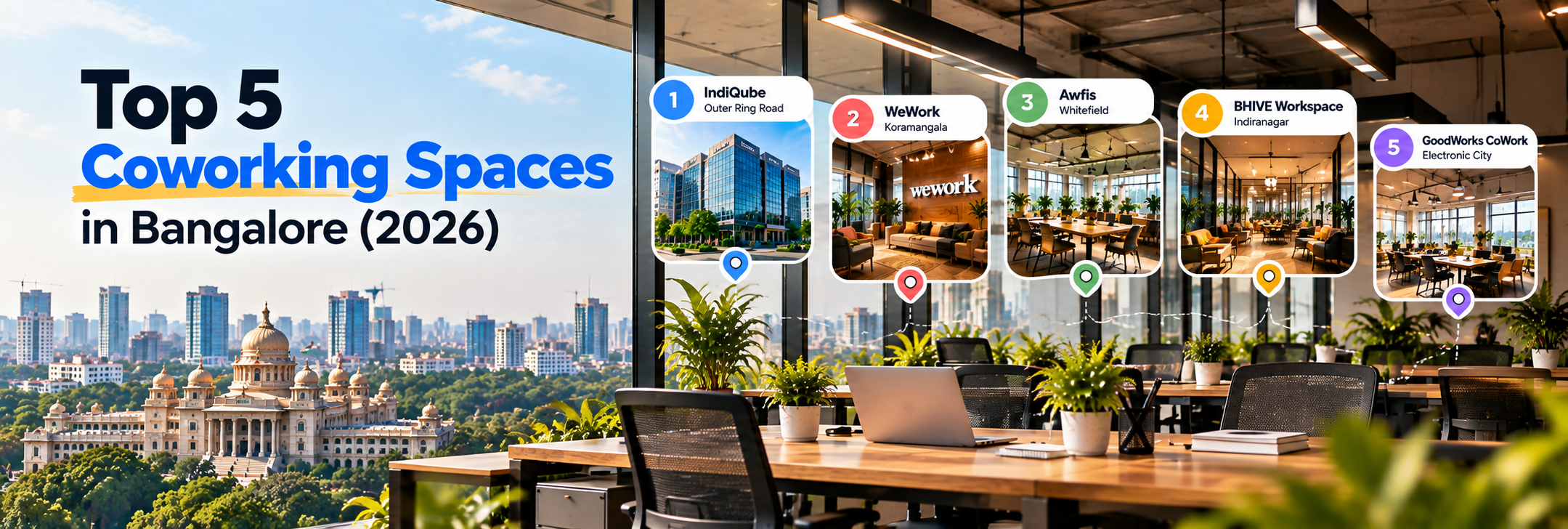
Top 5 Coworking Spaces in Bangalore: 2026 Guide
Looking for the best coworking spaces in Bangalore? Explore the top 5 options, compare locations, am...

Oct 8, 2026
Top 10 Coworking Spaces in Delhi (2026): Areas & Best Picks
Delhi-NCR's flex office market hit a record in 2026, with operators taking 45% of Q2 leasing. This g...

Oct 7, 2026
Top 10 Coworking Spaces in Gurgaon (2026): Prices, Locations & Amenities Compared
Compare 10 leading coworking spaces in Gurgaon by indicative desk pricing, micro-location, metro acc...