.png)
Flexofc Journal
How to Compare Coworking Spaces: A Complete Checklist for Businesses
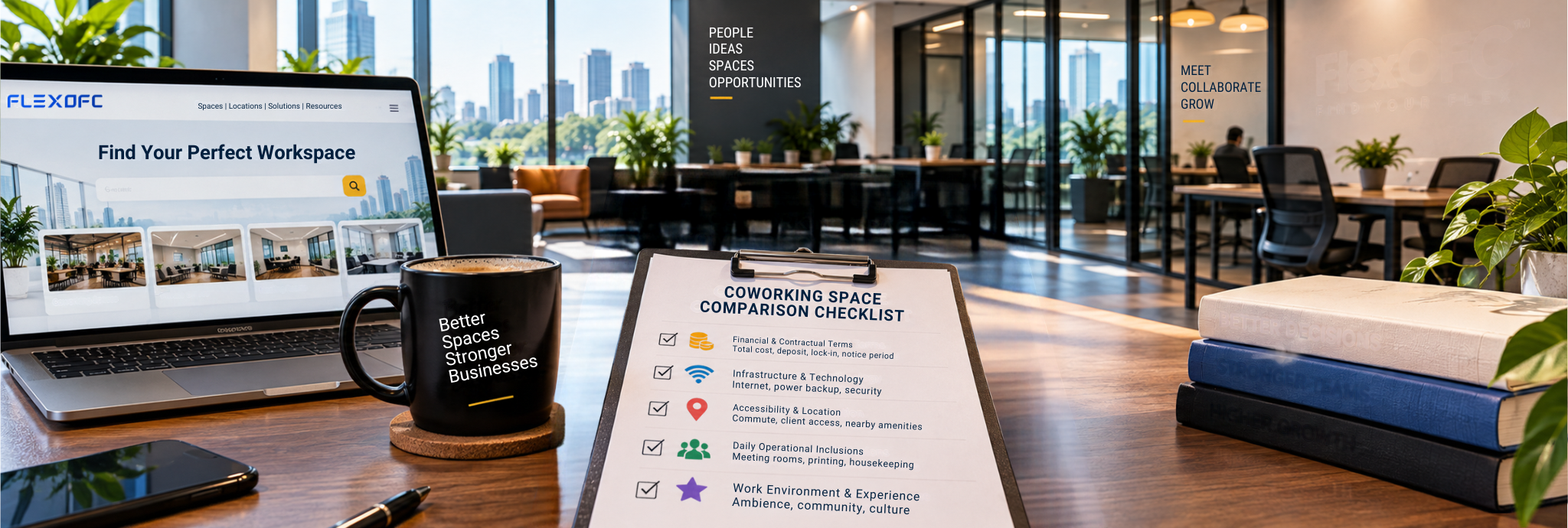
Comparing coworking spaces effectively requires evaluating five key categories: total operational cost, technology reliability, lease flexibility, location convenience and the quality of the work environment.
A workspace advertised at ₹8,000 per seat may look cheaper than one priced at ₹10,000. But what happens when the first operator charges separately for meeting rooms, printing, parking and additional internet services? That attractive per-seat price can quickly turn into an expensive month-end invoice.
For businesses, coworking space selection is not simply about finding the lowest rent. It is about understanding what you are paying for, what your employees receive and whether the workspace supports daily operations without unnecessary friction.
Whether you are a founder setting up your first office or a procurement lead comparing multiple proposals, this checklist will help you evaluate workspace options with total clarity.
The Ultimate Coworking Comparison Checklist
Pillar 1: Financial and Contractual Terms
Start with the net monthly cost, not the headline seat price. Most workspace comparisons become unreliable because businesses compare different pricing structures as if they are identical.
One operator may quote an all-inclusive monthly rate. Another may advertise a base seat price and stack extra charges for services your team uses regularly. Before comparing proposals, examine the complete financial picture:
Headline Price vs. True Monthly Cost: Ask each operator for a detailed commercial breakdown covering monthly desk or cabin charges, GST and applicable taxes, meeting room usage, electricity or utility charges, internet upgrades, parking fees, printing and administrative services, and additional employee access charges. Compare the final expected monthly invoice rather than the advertised starting price.
Security Deposit: Check how much deposit is required and how it is calculated. Clarify the deposit amount, refund conditions, deduction rules, refund timeline, and whether the deposit changes when you expand. A lower monthly rent does not justify a significantly higher upfront financial commitment.
Lock-in Clauses: Does the agreement require a 3-month, 6-month or 12-month commitment? Understand what happens if your team needs to leave early. Ask whether the contract includes early termination charges, a break clause, seat reduction rights, or deposit forfeiture conditions.
Notice Periods and Setup Fees: A 30-day notice period does not automatically mean you can exit during a 12-month lock-in. Review both clauses together. Also check whether onboarding, branding, furniture changes or access setup attract one-time charges.
Pillar 2: Infrastructure and Technology Audit
A coworking space can have premium interiors and unreliable internet—your employees will notice the second problem much faster. For businesses dependent on cloud applications, video calls and remote collaboration, infrastructure deserves a proper technical review:
Internet Redundancy: Ask whether the workspace has dual-ISP fiber connectivity or another form of automatic internet failover. Evaluate typical network performance, dedicated bandwidth options, support response times and network congestion during peak hours.
Power Backup: Power interruptions disrupt client calls, hard deadlines and access control systems. Check whether the building and workspace have continuous backup power and ask about the operator's documented Service Level Agreements (SLAs). Confirm if backup power covers elevators, access gates and individual desk outlets during extended outages.
Acoustic Isolation and Phone Booths: Noise management is often overlooked during property tours. A high-density workspace may work well for networking but become impossible for employees handling frequent client calls. Evaluate sound insulation in private cabins, meeting room privacy, the ratio of phone booths to overall seats, quiet work zones and noise levels during peak hours.
Wi-Fi Security: Ask how the operator manages network security. Key considerations include separate guest and employee networks, secure authentication, network segmentation where appropriate, IT support availability and policies for handling connectivity incidents.
Pillar 3: Accessibility and Location Convenience
The right office location directly impacts attendance, employee satisfaction and client perception. A workspace that looks affordable on paper becomes less attractive when employees spend an extra hour commuting every day:
Public Transport Access: Check proximity to metro stations, major highways and public transit hubs. For teams hiring across a city, convenient access makes recruitment and retention significantly easier.
Client Accessibility: If your business regularly hosts clients, investors or partners, consider ease of finding the building, visitor parking availability, reception protocols, building signage, meeting room access and visitor security procedures.
Surrounding Amenities: Evaluate the immediate neighborhood. Look for nearby restaurants and cafes, parking facilities, pharmacies, banks and ATMs, hotels for visiting clients, and everyday convenience stores.
Building Security & Operating Hours: Ask about visitor verification, access control systems, emergency procedures and building operating hours. If employees work early mornings or late evenings, confirm whether security and access policies support their schedules.
Pillar 4: Daily Operational Inclusions
Two coworking spaces may offer similar desks but deliver vastly different day-to-day experiences. The difference lies in the services included after you move in:
Meeting Room Credits: Ask how many complimentary meeting room hours are included each month. Confirm available room sizes, the reservation booking process, advance booking rules, additional hourly rates and cancellation policies.
Printing and Administrative Services: Check whether printing is included and whether there are monthly page caps. Ask about mail handling, courier acceptance and visitor coordination services. Small administrative fees accumulate quickly when used regularly.
Pantry Facilities: Refreshments seem minor during procurement but heavily influence daily employee experience. Check whether the workspace provides tea and coffee, drinking water, pantry access, kitchenette facilities or if beverages incur separate charges.
Housekeeping Standards: Inspect washrooms, common areas, desks and pantry spaces during peak working hours. Ask who handles maintenance requests and how quickly issues are resolved.
Pillar 5: Culture and Work Environment
The atmosphere of a coworking space influences how employees concentrate, collaborate and interact. There is no universally ideal workspace culture—the right choice depends entirely on how your team operates:
Quiet Focus Areas vs. Social Hubs: Some businesses require quiet environments with minimal distractions, while others thrive on networking opportunities and community events. Assess noise levels, desk density, availability of quiet zones, common area usage and actual employee concentration levels during your visit.
Guest Policies: Can employees bring external collaborators or clients? Are visitors permitted in meeting rooms, common areas or private cabins? Check whether guest access involves additional fees or advance registration.
Branding Customization: If you are leasing a private cabin or managed office, ask whether you can display your company logo or customize the interiors. Clarify permitted changes regarding wall signage, branding, furniture layouts, lighting and company-specific equipment.
Community Fit: Consider whether your team values active networking or prefers operational independence. A strong community offers value for business development, but it should complement your core work requirements rather than distract from them.
Comparing Coworking Categories
Parameter | Budget Shared Hubs | Mid-Tier Coworking Spaces | Enterprise Managed Offices |
True Monthly Cost | Lower base cost, but add-on charges frequently apply | Moderate pricing with broader standard inclusions | Higher overall commitment with customized end-to-end services |
Tech Redundancy | Basic connectivity; backup systems must be verified | Stronger infrastructure with dedicated IT support | Built around enterprise business continuity requirements |
Privacy Levels | Open seating with limited enclosed areas | Balanced mix of hot desks and private cabins | Fully dedicated private offices with strict access control |
Meeting Credit Ratios | Limited allowances; pay-per-use models | Moderate included credits based on seat count | Custom-negotiated room allowances and dedicated meeting suites |
Lease Commitment | Flexible month-to-month options | Flexible monthly and 6-to-12-month fixed plans | Structured around longer multi-year commitments |
Customization | Minimal to none | Moderate (minor signage or cabin adjustments) | High scope for full branding, layout and IT fit-out |
Ideal Business Stage | Freelancers, early-stage startups and cost-conscious teams | Growing startups, SMEs and regional branch offices | Established companies with strict operational and security needs |
The ideal category depends on your business model, team size and daily work patterns. A budget hub works for a small team that rarely hosts clients, while an enterprise managed office is justified when privacy, IT security and brand customization carry clear operational value.
How FlexOFC Makes Coworking Comparison Easier
Finding suitable workspace options often requires contacting multiple operators and requesting the same basic information repeatedly. Pricing, amenities, desk availability and contract terms are often presented in inconsistent, confusing formats.
FlexOFC simplifies this process by helping businesses discover and compare verified flexible workspaces with total clarity into the operational details that drive your decision.
As a zero-brokerage workspace discovery platform, FlexOFC enables founders, HR teams and procurement leads to explore verified office options across major cities with:
Transparent pricing structures
Side-by-side workspace comparisons
Verified amenity listings and technical specs
Flexible seating and cabin options
Direct location-specific details
Zero traditional broker markups or hidden fees
Instead of selecting a workspace based solely on photos or promotional pricing, you can shortlist options tailored to your actual operational requirements.
Frequently Asked Questions
1. What are the most important factors to compare in a coworking space?
The five core categories to evaluate are:
Total net monthly cost (including taxes and add-ons)
Internet redundancy and power backup reliability
Location convenience and transport connectivity
Included daily amenities (meeting credits, printing, pantry)
Contract flexibility (lock-ins, notice periods, seat scalability)
2. How do you calculate the true cost per seat in a flexible office?
Use this simple calculation:
True Monthly Cost Per Seat = Total Monthly Workspace Expenses ÷ Number of Allocated Seats
Include all recurring monthly charges such as base rent, GST, utilities, internet upgrades, parking fees, additional meeting room charges and administrative expenses. For example, if your total monthly workspace invoice is ₹2,50,000 for 25 seats:
₹2,50,000 ÷ 25 = ₹10,000 per seat per month
3. Should you take a day pass trial before signing a coworking lease?
Yes. A day pass trial reveals operational issues that property tours miss. Use trial days during peak working hours to evaluate internet stability, background noise levels, meeting room availability, chair comfort and actual workspace density.
4. How can businesses compare coworking spaces without paying broker fees?
Businesses can use zero-brokerage workspace discovery platforms like FlexOFC to explore available options. FlexOFC allows you to discover, compare and shortlist verified workspaces with transparent pricing and zero broker markups. Always confirm final commercial terms directly before signing your agreement.
Final Takeaway
The right coworking space is not necessarily the cheapest one—it is the space that delivers the highest operational value for your business requirements.
Compare total monthly costs, audit technology infrastructure, inspect location convenience, verify daily inclusions and read contract clauses carefully. A structured evaluation helps businesses avoid expensive surprises while securing a workspace that supports productivity, growth and long-term financial control.
When you are ready to shortlist options, visit FlexOFC at www.flexofc.com to compare verified flexible workspaces with transparent pricing and zero brokerage.
Need Help With This Topic?
Talk to the Flexofc team
If this article sparked a question about coworking, coliving, managed offices, or the right workspace setup, contact us and we'll help you narrow the best next step.
Contact UsRecommended for you

Oct 9, 2026
Top 5 Coworking Spaces in Bangalore: 2026 Guide
Looking for the best coworking spaces in Bangalore? Explore the top 5 options, compare locations, am...

Oct 8, 2026
Top 10 Coworking Spaces in Delhi (2026): Areas & Best Picks
Delhi-NCR's flex office market hit a record in 2026, with operators taking 45% of Q2 leasing. This g...

Oct 7, 2026
Top 10 Coworking Spaces in Gurgaon (2026): Prices, Locations & Amenities Compared
Compare 10 leading coworking spaces in Gurgaon by indicative desk pricing, micro-location, metro acc...