.png)
Flexofc Journal
How to Find an Office Without a Long-Term Lease: 5 Flexible Solutions for Businesses
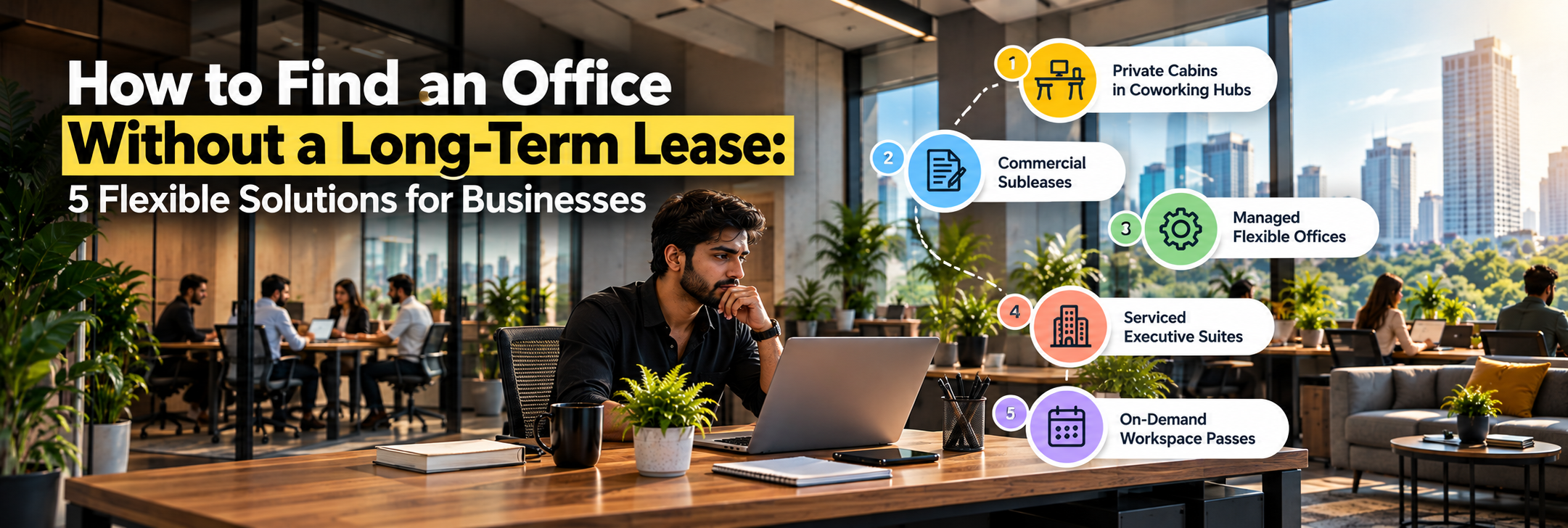
You can secure an office without a long-term lease by using private coworking cabins, commercial subleases, managed flexible offices, serviced executive suites or on-demand workspace passes.
For a growing business, that flexibility matters. A traditional commercial office lease can tie you to a three-to-five-year commitment with security deposits, fit-out costs, furniture expenses and ongoing maintenance obligations. If your headcount changes or the business enters a new market slower than expected, you may end up paying for space you no longer need.
The better approach is to match your office commitment to your actual occupancy and business forecast.
Here are five practical ways to rent office space without taking on a conventional long-term commercial lease.
1. Private Cabins in Coworking Hubs
Private coworking cabins are one of the simplest ways to get dedicated office space without taking on a traditional lease.
You get a lockable workspace inside a professionally managed coworking facility. Depending on the operator, contracts may be available on month-to-month, quarterly or six-month terms.
The major advantage is that the office is already operational. Furniture, internet, electricity, housekeeping and common-area access are generally bundled into the workspace fee.
Pros
Low or zero CapEx: No major furniture or office setup investment.
Faster move-in: Businesses can often occupy the space shortly after signing.
Flexible tenure: Shorter commitments are available depending on the operator.
Built-in infrastructure: Meeting rooms, lounges and reception areas may already be available.
Easy scaling: Additional cabins or desks can often be added as the team grows.
Cons
Less control over office design and building operations.
Meeting rooms and premium facilities may have additional usage charges.
Privacy and branding options vary by operator.
Best for
Startups, project teams, satellite teams and businesses testing a new location.
If your team needs a professional office for 5–20 people but you are not ready to predict your headcount three years from now, a private coworking cabin is worth evaluating first.
2. Commercial Subleases
A commercial sublease allows your business to occupy unused space inside another company's leased office.
For example, a company may have signed a larger office lease for 100 employees but now only needs 70 seats. Instead of leaving 30 seats unused, it may sublease part of the premises to another business.
This can create an opportunity to access a conventional office at a lower effective cost than taking a new lease.
Pros
Potentially lower rental costs
Existing furniture and infrastructure may be included.
Access to an established commercial building.
More traditional office environment than some coworking facilities.
Useful for businesses needing a specific location.
Cons
Lease terms can be more complicated.
The primary landlord may need to approve the sublease.
The sublease term may be limited by the original tenant's lease expiry.
Repairs and maintenance responsibilities must be clearly defined.
Internet, utilities and shared facilities may not be included.
Best for
Companies seeking a conventional office environment for 6–24 months without signing a new long-term lease.
Before signing, confirm who controls the premises, who receives rent, what happens if the head lease terminates and whether your business has direct rights against the landlord.
3. Managed Flexible Offices
A managed flexible office sits between traditional leasing and coworking.
The operator creates and manages an office specifically for your company. Depending on the provider, the space can include your preferred layout, furniture, meeting areas, branding and technology infrastructure.
Tenures may be more flexible than traditional commercial leases. A 12-month arrangement can be particularly useful for companies that need a dedicated office but do not want a three-to-five-year commitment.
Pros
Dedicated workspace with greater control.
Professional fit-out without the company funding the entire project.
Flexible tenure compared with conventional leases.
Facilities and maintenance are generally managed by the operator.
Better branding opportunities than standard shared coworking space.
Cons
Monthly costs can be higher than a conventional lease on a per-seat basis.
Custom requirements may increase the total price.
Exit and modification terms need careful review.
Best for
Growing companies, regional offices and businesses entering a new city.
This model works particularly well when the company knows it needs a dedicated office but cannot justify taking on a long-term real estate commitment.
4. Serviced Executive Suites
Serviced executive suites provide turnkey offices with shared professional services.
The workspace typically comes furnished with reception support, internet, utilities and access to meeting facilities. Some providers also offer administrative services.
This model is designed around convenience. Instead of managing landlords, contractors, furniture suppliers and utility connections, the business pays one workspace provider.
Pros
Turnkey setup
Professional reception and common areas.
Administrative support may be available.
Predictable operating costs.
Suitable for client-facing businesses.
Cons
Premium pricing can apply to highly serviced locations.
Customization may be restricted.
Shared services can come with usage limitations.
Best for
Consulting firms, financial services teams, legal professionals, client-facing businesses and branch offices.
If presentation and convenience matter more than maximum control over the premises, an executive suite can make financial and operational sense.
5. On-Demand Day Passes & Team Pass Pooling
Not every company needs an office five days a week.
A remote-first business with 20 employees might only bring people together once or twice a week. Paying for 20 dedicated seats every month could therefore create significant unused capacity.
Day passes and team pass pools offer another approach.
The company can purchase workspace access when employees actually need it. Depending on the provider, employees may use hot desks, meeting rooms or other shared facilities.
Pros
Pay based on actual usage.
No long-term office commitment.
Useful for distributed teams.
Easy to test locations before taking permanent space.
Minimal setup and administration.
Cons
No guaranteed permanent seating.
Costs can rise if usage becomes frequent.
Team members may work from different areas.
Less suitable for businesses requiring fixed storage or dedicated infrastructure.
Best for
Remote teams, freelancers, consultants and companies that need physical workspace one or two days per week.
The key is to calculate your actual office usage. If the team only needs 100 desk-days per month, buying capacity for 400 desk-days may not be rational.
How to Evaluate a Flexible Office Lease: A Practical Checklist
Choosing flexible workspace is not simply about finding the lowest monthly rent. Compare the total occupancy cost, contractual risk and operational fit.
1. Audit Occupancy Against Headcount
Start with actual attendance rather than total employee count.
If you have 50 employees but only 25 typically work from the office, a 50-seat office may be unnecessary.
Track:
Average daily attendance
Peak attendance
Hybrid schedules
Meeting room demand
Visitor frequency
Future hiring plans
Buy capacity based on usage rather than headcount alone.
2. Identify Hidden Fees
The headline monthly price does not always represent your final occupancy cost.
Ask whether the agreement includes:
High-speed Wi-Fi
Electricity
HVAC
Housekeeping
Parking
Meeting room credits
Printing
Access cards
IT support
After-hours access
Also check overage rates for meeting rooms and additional services.
3. Check Deposits and Exit Clauses
A short-term agreement is only flexible if you can actually exit it without excessive financial exposure.
Review:
Security deposit amount
Refund timeline
Notice period
Early termination charges
Renewal terms
Lock-in period
Restoration obligations
A 30-day notice period can create a very different risk profile from a 90-day notice period even when both offices advertise themselves as flexible.
4. Verify IT, Security and Access
Do not treat technology and security as secondary details.
Check the quality of internet connectivity, network segregation, backup connectivity and access controls.
For teams handling sensitive information, also evaluate visitor management, CCTV, access logs and data-security policies.
Acoustic privacy matters too. A beautifully furnished office is not useful if confidential calls can be heard from the corridor.
Traditional Lease vs Sublease vs Flexible Coworking Office
Factor | Traditional Lease | Commercial Sublease | Flexible Coworking Office |
Minimum Lease Term | Often 3–5 years | Usually tied to head lease | Often monthly to 12+ months |
Upfront CapEx | High | Low to moderate | Low or near zero |
Furniture & IT Costs | Usually tenant-funded | May already exist | Usually included or available |
Scalability Speed | Slow | Moderate | Fast |
Maintenance Burden | Higher | Depends on agreement | Usually managed by operator |
Exit Flexibility | Low | Moderate | High, depending on contract |
The cheapest monthly rent is not always the lowest total cost. Factor in fit-out, furniture, deposits, maintenance, utilities, exit costs and the value of your team's time.
How FlexOFC Makes Short-Term Office Hunting Easier
Finding flexible workspace can become difficult when businesses have to contact multiple operators, compare commercial terms and determine whether advertised prices include all relevant costs.
FlexOFC simplifies the discovery process by bringing flexible workspace options into one platform.
Through FlexOFC, businesses can discover verified workspace options such as private cabins, flexible offices and short-term workspaces while comparing relevant details before making a decision.
The platform is designed around direct and transparent workspace discovery without middleman broker fees or hidden broker markups.
For businesses evaluating a short-term office, that means less time spent navigating traditional brokerage channels and more time comparing the factors that actually affect the decision: location, capacity, workspace type, flexibility and commercial terms.
Visit FlexOFC to explore flexible workspace options for your business.
Frequently Asked Questions
What is the shortest lease term you can get for a private office?
The shortest term depends on the operator. Some coworking providers offer monthly private office agreements while others may require three, six or twelve months. Always confirm the lock-in period and notice requirement rather than relying only on the advertised tenure.
Is renting a short-term flexible office more expensive than a traditional lease?
The monthly cost per seat can be higher than a traditional lease. However, flexible offices often include furniture, internet, utilities, maintenance and common facilities. Compare total occupancy cost rather than rent alone to determine which option is financially better.
Can a company customize a short-term private cabin with its own branding?
Some operators allow limited branding such as signage, wall graphics or branded furniture. Major modifications may not be permitted. Confirm customization rules before signing the agreement.
Can I rent office space without paying a large security deposit?
Possibly. Deposit requirements vary by operator and workspace model. Flexible offices and coworking providers may offer lower deposit requirements than conventional commercial leases. Always compare the deposit amount, refund conditions and exit terms.
Final Takeaway
You do not need a three-to-five-year commercial lease just because your business needs a professional office.
Private coworking cabins, commercial subleases, managed offices, serviced suites and on-demand workspace can all provide office access with significantly greater flexibility.
The right choice depends on your actual occupancy, expected growth, required privacy, technology needs and exit horizon.
Before committing, calculate the full cost and read the exit clause carefully. A flexible office only creates value when the contract is flexible enough to match the way your business operates.
Need Help With This Topic?
Talk to the Flexofc team
If this article sparked a question about coworking, coliving, managed offices, or the right workspace setup, contact us and we'll help you narrow the best next step.
Contact UsRecommended for you

Oct 9, 2026
Top 5 Coworking Spaces in Bangalore: 2026 Guide
Looking for the best coworking spaces in Bangalore? Explore the top 5 options, compare locations, am...

Oct 8, 2026
Top 10 Coworking Spaces in Delhi (2026): Areas & Best Picks
Delhi-NCR's flex office market hit a record in 2026, with operators taking 45% of Q2 leasing. This g...

Oct 7, 2026
Top 10 Coworking Spaces in Gurgaon (2026): Prices, Locations & Amenities Compared
Compare 10 leading coworking spaces in Gurgaon by indicative desk pricing, micro-location, metro acc...